New · First edition, November 2026
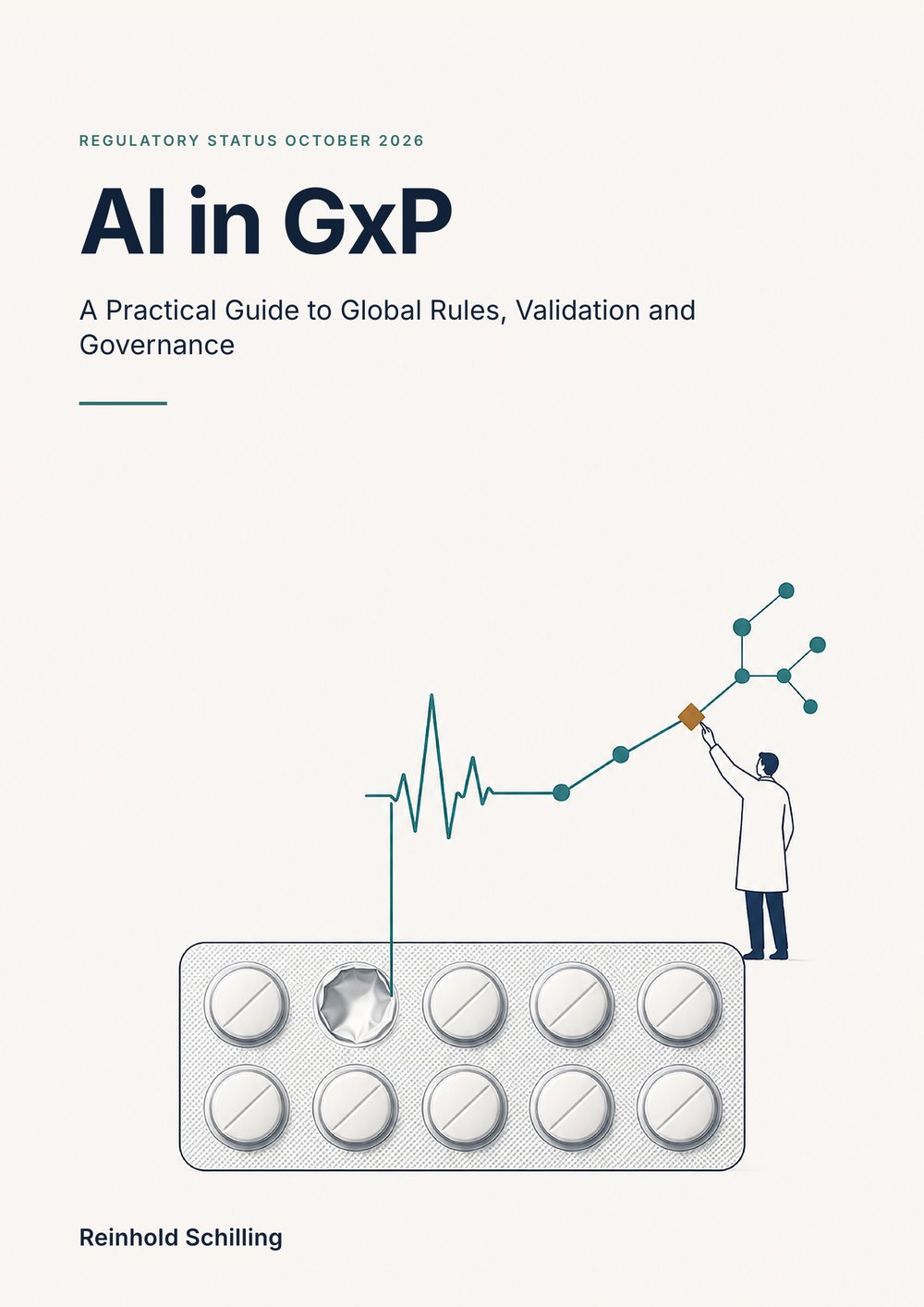
AI in GxP
A Practical Guide to Global Rules, Validation and Governance
Reinhold Schilling
Between 2024 and 2026 regulators produced a dense run of documents on AI: the EMA reflection paper, the FDA draft credibility framework, joint FDA/EMA principles, the EU AI Act and the draft EU GMP Annex 22. In April 2026 an FDA warning letter took a drug manufacturer to task for letting AI agents stand in for its quality unit. This book sorts those documents by legal weight and turns them into decisions a regulated company can take.
PDF · DIN A4 · 241 pages · full colour · status of sources 26 October 2026 · secure payment via Digistore24
What the book covers
The book keeps four things apart: binding requirements, published guidance, consultation drafts and the author’s own recommendations. Chapters that lead to project work end with a short checklist, and the appendices give you templates, worked examples and model texts to adapt.
- Ten things every leader needs to know, and four cases that changed the conversation
- The global rulebook: United States, European Union, ICH and the rest of the world
- EU AI Act after the Digital Omnibus, draft EU GMP Annex 22 and revised Annex 11
- Use-case triage, model risk tiers and the one-page context of use
- Baseline and acceptance criteria set before testing
- Buying AI: suppliers, SaaS and AI features switched on by an update
- Generative AI and agents in daily GxP work
- GAMP 5, data integrity, regulated MLOps, testing, drift and change control
- An AI management system inside your QMS, AI literacy and automation bias
- Area profiles for GMP, GCP, GLP, GVP, GDP and regulatory affairs
One agreed path from idea to validated use
- 1
Scope check
Is it GxP-relevant? Which lane?
- 2
COU summary
What it does, which decision, which limits
- 3
Baseline
How well does today's process work?
- 4
Criteria first
Acceptance criteria approved before testing
- 5
Oversight
A justified oversight model
- 6
Monitoring plan
Signals, levels, responses, owner
Part C gives you a template for each step, and three worked examples follow one AI use each from triage to change: deviation classification, automated visual inspection and generative case narratives in pharmacovigilance.
Where to start
Executive
Part A, the “In brief” box of every chapter and Chapters 10, 22 and 23. Then the model AI policy, the FAQ and the self-assessment.
Quality or validation
Part A, Parts B, C and E, Chapters 16 and 20 and your area profile in Part F. Then the triage record, the COU summary and the worked examples.
IT, data science or engineering
Part A, Part D and Chapters 14, 15 and 23. Then the validation plan outline, the retraining protocol and the monitoring plan.
Project lead in any function
Part A, Part C, Chapter 24 and your area profile. Then the triage record, the COU summary and the acceptance-criteria worksheet.
Inside
- 241 pages, 31 chapters
- 112 figures
- 9 templates and 8 model texts
- 3 worked examples, FAQ and a self-assessment
About the author

Reinhold Schilling is Head of Global Pharmacovigilance and EU-QPPV at an international pharmaceutical company and has worked in drug safety since 2011. His work spans pharmacovigilance, regulatory affairs and AI governance. He also teaches pharmacovigilance as an independent lecturer and trainer, including at Goethe Business School (Pharma MBA) and Hochschule Reutlingen.
Questions
Which format do I get?
A PDF in DIN A4 with all figures in colour, a clickable table of contents and bookmarks for every chapter.
How do I receive it?
Right after payment you get a download link by email from Digistore24, who handles payment and invoicing.
Can I use the templates at work?
The templates in Appendix A and the model texts in Appendix G are written to be adapted to your own procedures. The PDF itself is licensed for personal use; for team or company licences, write to [email protected].
Is there a printed edition?
Yes, as an A4 paperback on Amazon, where a Kindle edition is also available.
How current is the regulatory content?
It reflects documents publicly available on 26 October 2026. Rules keep changing, and the original texts prevail, so check for later updates before relying on a dated statement.
Is this legal or regulatory advice?
No. The book does not replace the regulations it discusses, your own procedures or the judgement of qualified professionals who know the product, process and jurisdiction.
AI in GxP – PDF eBook, 39 €