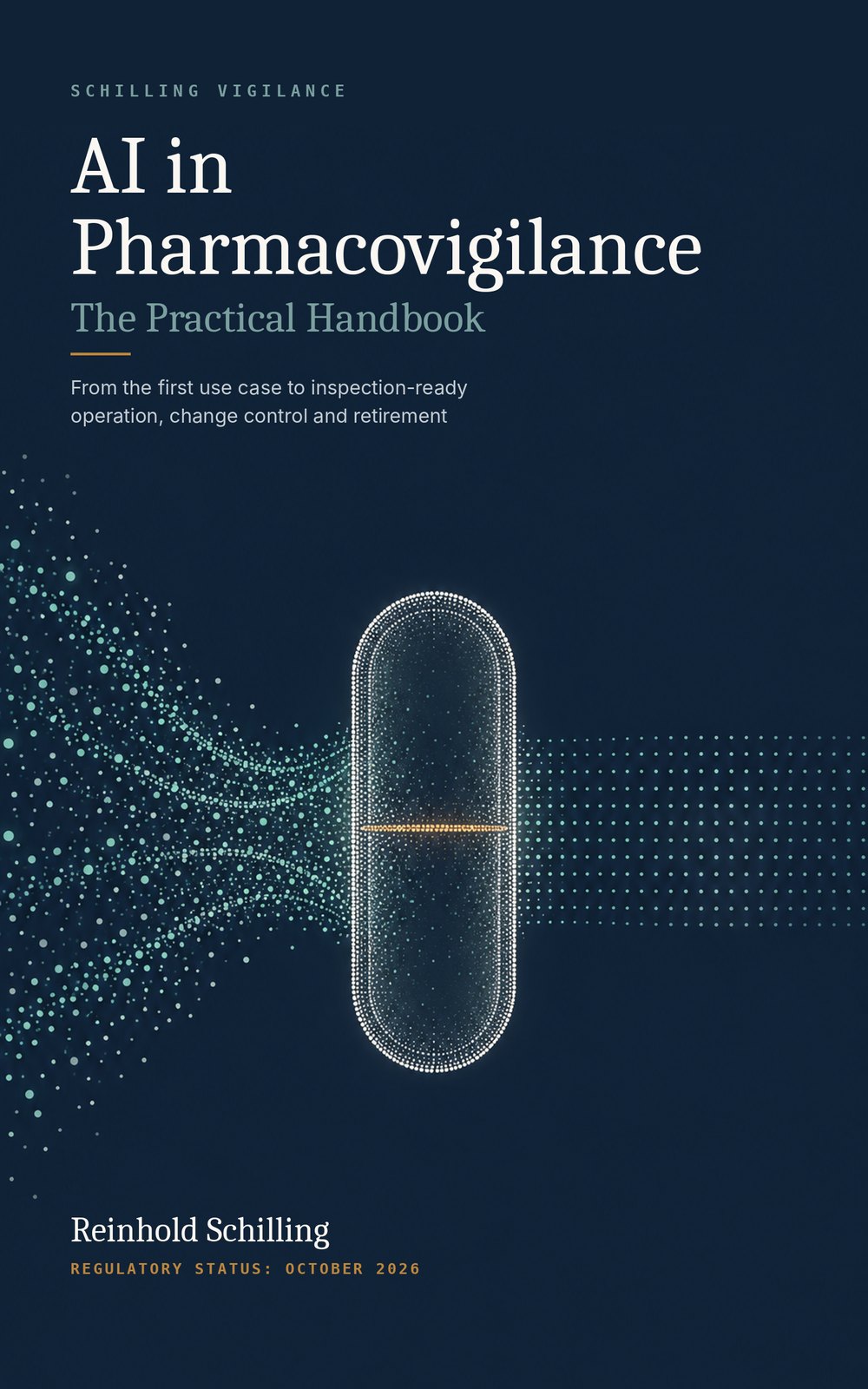
New · First edition, November 2026
AI in Pharmacovigilance
The Practical Handbook
Reinhold Schilling
Many PV departments already use AI somewhere: a literature filter, a coding suggestion, a narrative draft. Far fewer can show an inspector who approved it, what it was tested against and who checks its output today. This handbook takes one use case from the first idea to inspection-ready operation, and on through change control, monitoring and retirement.
PDF · DIN A4 · 136 pages · full colour · regulatory status October 2026 · secure payment via Digistore24
What the book covers
It is a working book. Most chapters end in checklists, decision tables or templates you can adapt, review and approve within your own quality system. It also introduces PHAIR, a structured assessment for AI in pharmacovigilance.
- Regulatory status October 2026: PV rules, AI Act after the Digital Omnibus, draft Annex 22
- Intended use, model risk, zones and decision rights
- Pilots, reference standards and the errors proposal-only review hides
- Validation, change control and silent supplier changes
- Human oversight that works as a control, and how to test it
- Data fitness, lawful processing and information security
- Supplier qualification, contract clauses and service levels
- A statistics primer in PV terms: confusion matrix, subgroups, uncertainty
- Use cases: case intake, literature, signals, aggregate reports, agents
- Inspection readiness, including how to describe AI in the PSMF
Five phases, four gates
- 1
Define
Use case, intended use and whether AI is needed at all
- 2
Assess
Risk, GxP impact and validation strategy. Gate 1: approval to pilot
- 3
Pilot
Representative data and a reference standard. Gate 2: evidence reviewed
- 4
Validate
Procedures, records, fallback and training. Gate 3: go-live
- 5
Go live
Controlled operation with monitoring triggers. Gate 4: operation confirmed
Change control after go-live feeds back into the lifecycle
Each gate comes with the evidence an inspector will ask for, and a gate decision record to document it.
Where to start
QPPV or head of PV
Chapters 2, 3, 4, 12, 15 and 23, then the gate checklists in Chapter 26.
Owner of a use case
The matching process chapter in Part IV, then Chapters 4 to 11 in order.
QA or validation
Chapters 6, 8, 10, 12, 16 and 21, and the templates in Chapter 25.
Small PV organisation
Chapter 24 (the lean path), then Chapters 5, 6, 7 and 14.
Supplier
Chapters 14 and 16: what your customers have to ask you, and why.
Inside
- 136 pages
- 23 figures
- 15 templates
- Gate checklists, KPIs and four worked examples
About the author

Reinhold Schilling is Head of Global Pharmacovigilance and EU-QPPV at an international pharmaceutical company and has worked in drug safety since 2011. He also teaches pharmacovigilance as an independent lecturer and trainer, including at Goethe Business School (Pharma MBA) and Hochschule Reutlingen. The handbook grew out of his course “Artificial Intelligence in Pharmacovigilance”.
Questions
Which format do I get?
A PDF in DIN A4 with all figures in colour, a clickable table of contents and bookmarks for every chapter.
How do I receive it?
Right after payment you get a download link by email from Digistore24, who handles payment and invoicing.
Can I use the templates at work?
Yes. The templates in Chapter 25 may be adapted for use within your own organisation. The PDF itself is licensed for personal use; for team or company licences, write to [email protected].
Is there a printed edition?
Yes, as a full-colour A4 paperback on Amazon, where a Kindle edition is also available.
How current is the regulatory content?
It reflects the sources listed in the book as of October 2026. Requirements keep changing, so check for later updates before relying on a dated statement.
Is this legal or regulatory advice?
No. The book is for education and training. It does not replace your own procedures, legal review or the applicable legislation.
AI in Pharmacovigilance – PDF eBook, 39 €